
Your Domain Name Shouldn’t Need an Explanation
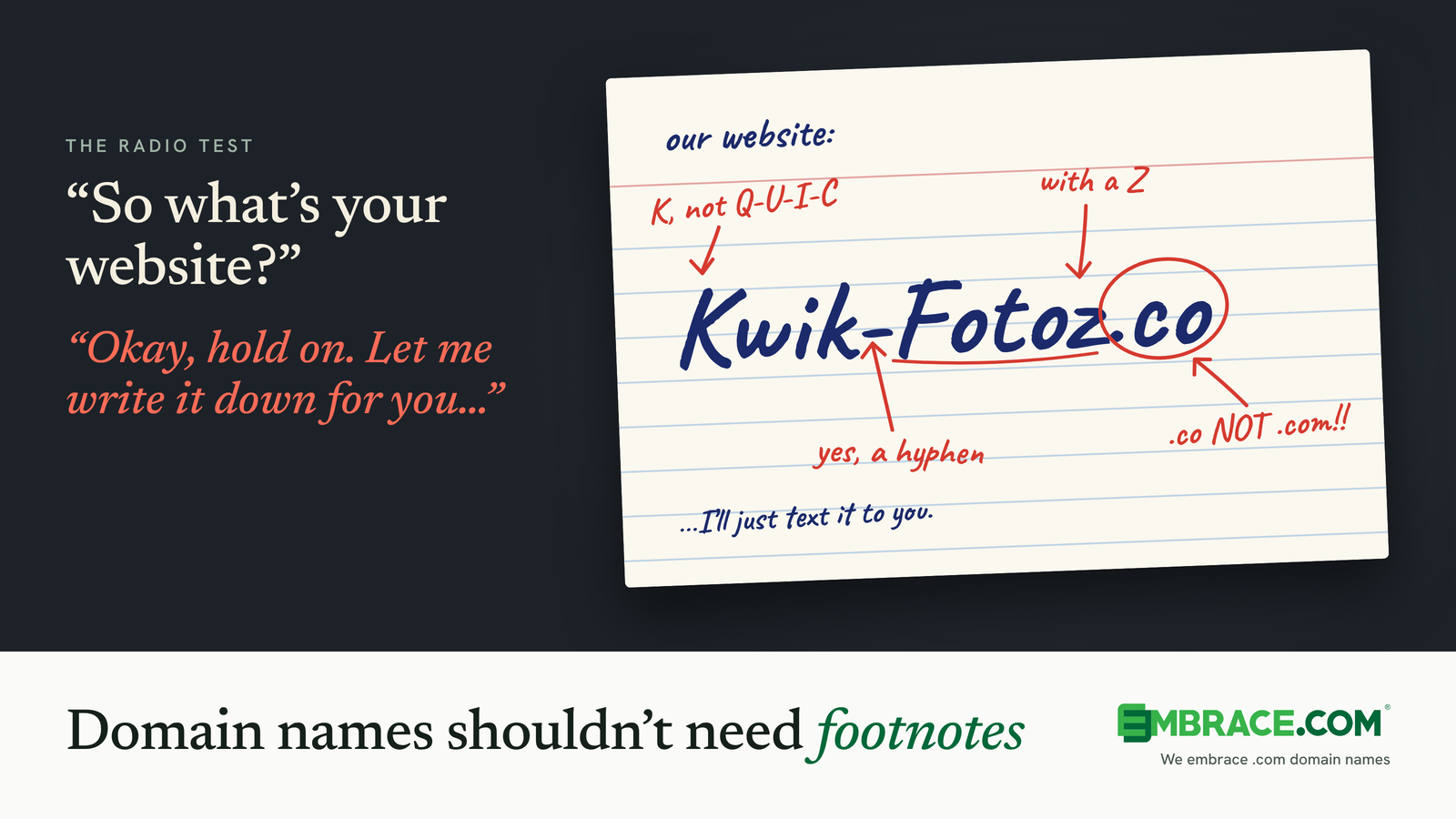
A good domain name should be easy to say, easy to remember, and easy to type.
Ideally, it should not require a follow-up explanation.
If someone asks for your website and the answer includes, “It’s spelled a little differently,” “There’s a hyphen,” “We use the other extension,” or “It’s the word you’re thinking of, but with one letter changed,” you have already created some friction.
Sometimes that friction is minor.
Sometimes it means the person never gets to the website at all.
The same idea applies to the radio test.
If someone hears your company name on a podcast, in a conversation, at a conference, or on the radio, can they reasonably figure out how to get to your website without seeing it written down?
Intentional misspellings can make that much harder.
Dropping a vowel, swapping a letter, using an unusual plural, or creating a clever spelling may make a brand name look distinctive on a screen. But if someone only hears it, there is a good chance they will type the conventional spelling instead.
That can send traffic somewhere else.
It can also create problems with email. A customer may send a message to the spelling they assume is correct, never realizing it went to the wrong domain name or didn’t arrive at all.
Not every company can start with its ideal domain name. Sometimes a workaround is necessary, especially in the early days.
But as a company grows, those little explanations start to matter more.
A strong domain name should make the company easier to find and easier to remember.
If you have to explain the domain name every time you say it, the domain name may be the problem.